


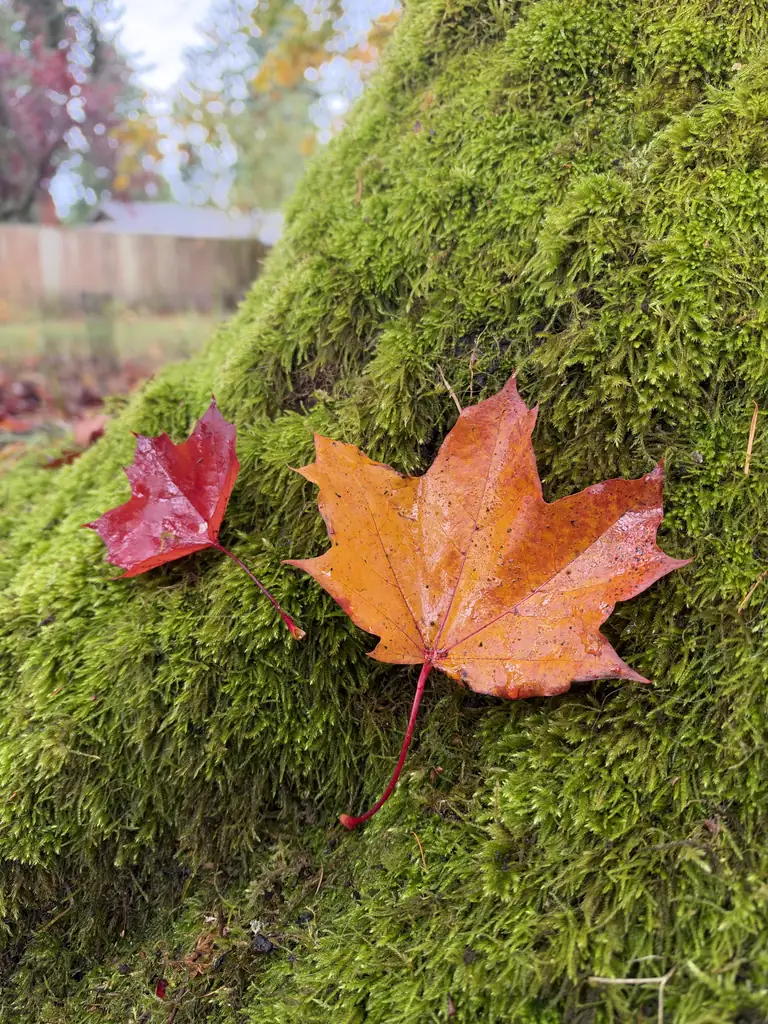
There is a moment each year when the world seems to change its voice.
The light softens. The air takes on a chill that wasn’t there the week before. Leaves gather along the edges of sidewalks, and the smell of wet earth rises from the ground after rain. We notice the yellow of a maple against the dark green of a cedar, or the way fog settles between trees before the day has properly begun.
For many of us, autumn feels different from the other seasons. Its beauty can be almost aching. We want to linger outside, then return to a warm room. We may feel nostalgic without knowing what, exactly, we are remembering.
Why does fall have this effect on us?
Part of the answer is personal: childhood, familiar places, and the rituals we repeat each year. Another part may reach further back. Our senses developed in a world where changes in color, scent, temperature, and light could carry useful information. That makes an evolutionary connection plausible, but it does not prove that we inherited a particular love of autumn.
Perhaps the more interesting question is how the things we are equipped to notice become the things we learn to love.
The colors we were built to notice
In a deciduous forest, autumn announces itself through color. Green gives way to gold, amber, rust, and red. Even a single bright tree can transform an ordinary street.
Many primates, including most humans, have three types of color-sensitive cone cells. Researchers have investigated whether this color vision helped primates distinguish food against foliage. In a study of four primate species in Uganda, Nathaniel Dominy and Peter Lucas found that a red-green color signal distinguished the young leaves the animals ate, and that this signal was associated with leaf nutrition and tenderness.
The importance of fruit detection is another line of research. Which foods and circumstances mattered most remains a more complicated question than a single explanation can settle.
None of this establishes that people evolved specifically to admire fall foliage. A maple leaf turning red is not evidence of an inherited autumn aesthetic. It does suggest a useful distinction: noticing a color and finding it beautiful are related questions, but they are not the same question.
Our preferences also respond to experience. In a 2017 study by Karen Schloss and Isobel Heck, participants rated the same colors across eleven weeks of fall. Preference for leaf-associated colors rose around the period of strongest leaf color, then declined toward winter. People who liked fall-associated things more tended to show a larger seasonal increase.
That is evidence of preferences changing alongside the season, rather than proof of a universal response. The colors around us and the associations we bring to them both seem to matter.
Autumn may help teach us to love its colors.

The memory held in a scent
If color is autumn’s announcement, scent is its quiet signature.
Wet leaves, damp bark, mushrooms, rain-darkened soil: together they create an atmosphere that can be difficult to describe but instantly recognizable. There is no single autumn smell. Its ingredients vary with the place and what is growing, falling, and breaking down there.
One contributor to the smell of moist soil is geosmin. Research by Jiaoyang Jiang, Xiaofei He, and David Cane identified how a soil bacterium produces this earthy-smelling compound. Geosmin is one part of the picture, not a chemical explanation for every woodland scent.
The memory a smell brings with it can be just as striking as the smell itself. A familiar scent may recall a school morning, a path through the woods, or a house we once lived in.
In a study comparing scent and visual memory cues, Rachel Herz and Jonathan Schooler found that participants rated memories as more emotional when recalling them in the presence of the relevant odor. They also tended to feel more brought back to the original event. That finding helps explain why a familiar seasonal scent can feel so personal, although it does not mean every smell produces a vivid memory for everyone.
There is an evolutionary question here too. Odors can carry information about food and other features of an environment. But a sense that helps an animal navigate the world does not, by itself, explain why a particular person loves the smell of wet leaves.
Our memories give those signals a history. What smells like the beginning of winter to one person might smell like a childhood walk to another.
A season of gathering in
Autumn can change what we want to do with an evening.
As the days shorten, many of us become more attentive to home. We make soup, pull out heavier blankets, and give ourselves a project to return to after dinner. Warmth feels especially inviting when the air beyond the window is cold.
It is tempting to see these rituals as an echo of preparing for winter. In places with cold seasons, food, shelter, and clothing have obvious practical importance. Being ready for the weather can still feel satisfying.
But there is no simple scientific line connecting an ancestor storing food to our enjoyment of a wool blanket. Family traditions, culture, our homes, and the lives we lead all shape what we associate with fall. Some people welcome the early evenings; others miss the light. In other climates, autumn may look and feel very different.
We can enjoy the thought of gathering in without turning it into a claim about inherited behavior.
Sometimes the ordinary contrast is enough. A warm room after a cold walk. A lamp beside a chair as dusk arrives. A familiar pot on the stove. The season gives things we already own a little more presence.
The beauty of change
Autumn also gives us a reason to look again.
A tree at its brightest may be bare within a week. Wind can scatter a canopy overnight. A familiar path changes between visits, even when we have done nothing more adventurous than leave the house by the same door.
Its beauty is temporary, and knowing that may be part of what draws our attention. We need not turn that feeling into a scientific claim to recognize it.
In parts of the Pacific Northwest, the contrast can be especially vivid. Red and yellow leaves stand against evergreens that hold their color through winter. Rain darkens bark. Moss brightens. Fog softens the distance.
We bring our senses, accumulated memories, and the circumstances of our lives to that view. There is room for all of them in the affection we feel for a season.

Take a little of the season home
On your next walk, try noticing one color, one scent, and one sign of change. A familiar street is enough. So is a seat outside or a view from a window if that suits the day better.
Give each observation a few words. You might write “yellow leaves against wet cedar,” “earth after rain,” and “the light gone before dinner.” There is no need to identify every tree or turn the outing into a project.
At home, let one detail become something small: a page of colors, a photograph in a field notebook, or a note to return to the same place next week. If you are with someone, compare what each of you noticed. The same walk can leave two different impressions.
Perhaps the most interesting thing about our love of autumn is not whether evolution programmed us to enjoy it. The research here cannot make that claim. It gives us smaller, more useful pieces: color vision that helps distinguish parts of a landscape, preferences that shift with experience, and scents that can bring emotion to a memory.
The next time you step into the cool air and feel that familiar affection for fall, you do not have to settle its origin before enjoying it. You can notice what is changing, stay a little longer if you want to, and bring the impression home.
I hope this finds you well,
Scott