


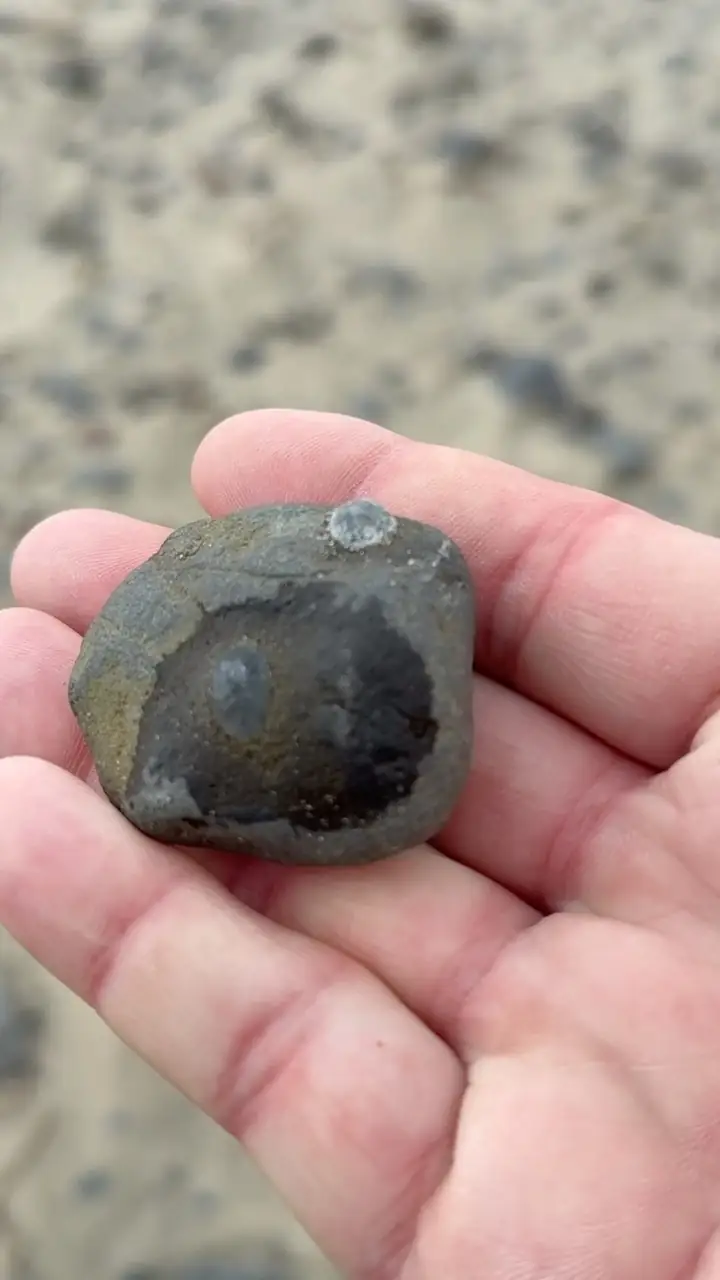
A rock containing an agate, found on the Oregon coast. Photograph by Scott.
I found this rock on the Oregon coast. It’s dark and rounded, small enough to fit in the palm of a hand, with an agate visible within the surrounding stone.
On a beach, a stone can be part of the ground until someone picks it up. Then it becomes a particular thing. You turn it over, look at its markings, and feel its weight. What seemed like a surface to walk across becomes a place full of individual discoveries.
There is something wonderfully familiar about that gesture. We can carry a phone capable of showing us almost anything in the world and still find ourselves bending down for a rock.
Why does this one catch our attention? And why, once we have looked at it, do we sometimes want to bring it home?
There is no established scientific explanation that gives us a special inherited instinct for collecting pretty stones. Several familiar tendencies may come together: curiosity, attention to color and pattern, the pleasure of a discovery, and the meanings we attach to objects.
One clue begins with what stands out. In a review of visual attention, researchers Jeremy Wolfe and Todd Horowitz describe how differences in features such as color and orientation can guide our attention, alongside what we are looking for and what experience has taught us to value.
It is easy to imagine those influences meeting on a beach. A pale stripe interrupts a field of dark stones. A familiar color sends you looking for another. Something catches your eye, and curiosity brings it closer.
Looking can become a pleasure of its own. Once you begin examining stones, the next few steps hold possibilities. You cannot know exactly what you will find. A walk acquires another small purpose, one that leaves plenty of room for wandering.
The possibility that our ancestors also noticed unusual stones reaches astonishingly far back.
The Makapansgat pebble was found in a South African cave deposit associated with early human ancestors. Robert Bednarik, who studied the stone, describes its deposition as dating to roughly 2.5 to 3 million years ago. Its markings resemble a face, and his microscopic examination found those features to be natural.
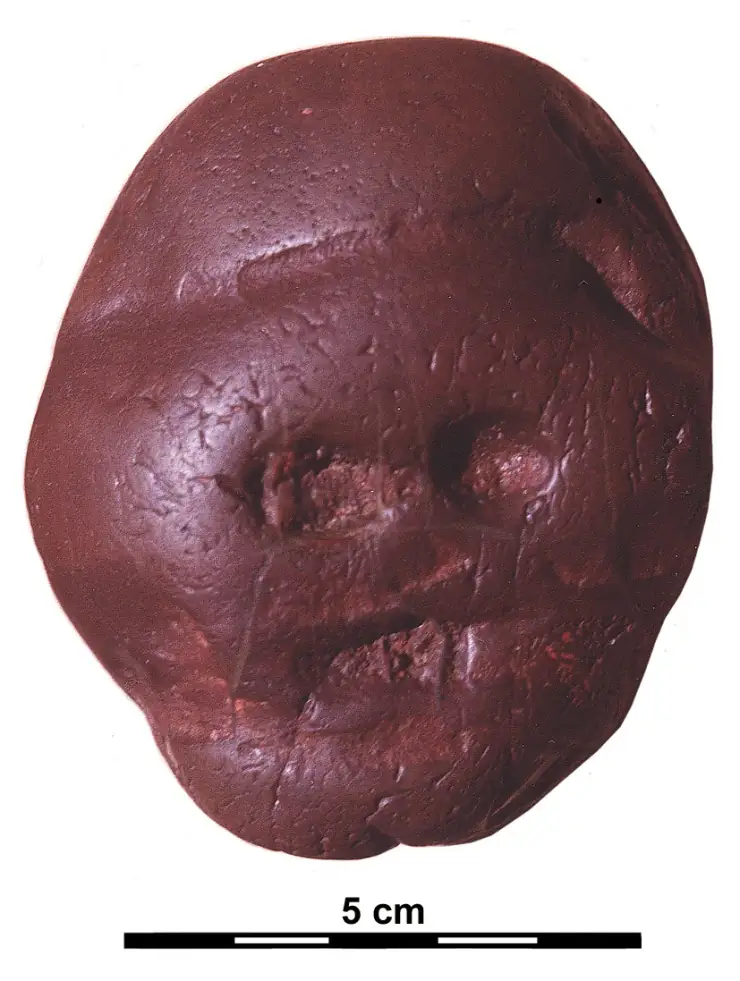
Robert G. Bednarik, 2013. Pleistocene Palaeoart of Africa, Figure 1. CC BY 3.0. Resized; original scale bars retained. Open larger view ↗
Researchers have proposed that an early ancestor carried it into the cave because of its striking appearance. The reason it was moved, and whether its finder saw a face, remain unknown. It cannot establish that rock collecting came before art, or tell us what beauty meant to the creature that carried it.
Still, the possibility is compelling. An ancestor might have noticed something unusual in a natural object and wanted to keep looking at it. Across an immense distance of time, that is a gesture we can imagine.
A related example comes from Qesem Cave in Israel. In a 2018 study, archaeologist Ella Assaf described seventeen unusually small, unmodified flint pebbles that showed no signs of practical use under examination. She proposed that their visual qualities may have influenced their selection. In the close-ups below, you can compare the pale branching marks on pebble e with the mottled surface of pebble j. Their ancient finders’ reasons for keeping them remain an interpretation.
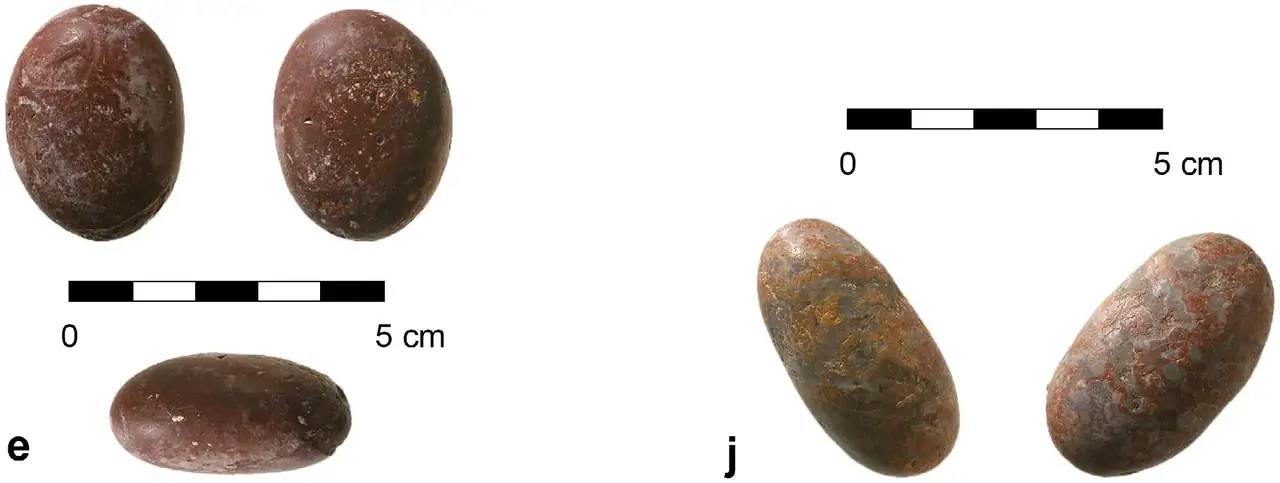
Photograph: Pavel Shrago. Ella Assaf, 2018. Paleolithic aesthetics, Figure 7. CC BY 4.0. Resized; original scale bars retained. Open larger view ↗
It also offers a lovely way to think about creativity. Our involvement with beauty can begin with recognizing it. Before deciding what to paint, photograph, arrange, or make, we find ourselves interested in something already there.
A stone might suggest a landscape, a pattern for fabric, or a combination of colors to try on paper. It can also remain a stone that is satisfying to hold and examine. Either response gives us something to return to.
Wanting to keep it introduces another part of the story.
Psychologists have studied how ownership can affect value. In experiments using coffee mugs, Carey Morewedge and colleagues found that owning a mug increased the value participants assigned to an identical one. Ownership itself helped change their judgment.
That finding offers one possible way to think about the shift from a stone to your stone. But the circumstances of a find can give it a more particular meaning, too. Someone else might see an ordinary pebble. For its finder, it might recall a stretch of coast, the person beside them, or an afternoon they would otherwise have trouble separating from all the others.
Perhaps part of wanting to take it home is wanting another way back to that moment. A small object can give a memory somewhere to land.
On your next walk, you might spend a few minutes looking closely at the ground. Notice what draws you in, then try putting it into words. It could be a line running around a stone, a speckled surface, or the way a color changes when wet. A photograph or a quick sketch can keep the discovery with you. Where collecting is permitted, a modest find and a note of its place can become the beginning of a small personal collection.
You might eventually want to learn its geological name. You might use its colors in a project. You might simply enjoy seeing it again.
Looking for agates on the Oregon coast
If you would like to try looking for agates yourself, these resources offer a place to begin:
- Travel Oregon’s guide to hunting for coastal agates introduces the search, suggests beaches along the coast, and explains how the seasons affect what is exposed.
- Yachats’ agate-hunting guide describes visual clues to look for, including translucence, colors, and banding.
- Oregon State Parks’ collecting guidance answers “Can I collect driftwood, shells, or agates from the beach?” and links to the ocean shore recreation rules.
Before setting out, check the rules and access notices for your chosen beach, the tide and weather forecasts, and the Oregon Coast Visitors Association’s beach safety guidance.
After all our inventions, a stone on a beach can still be enough to make us stop. There is an unattributed line that captures the humor and affection in that beautifully:
“Civilization has failed to defeat rock.”
I hope this finds you well,
Scott