
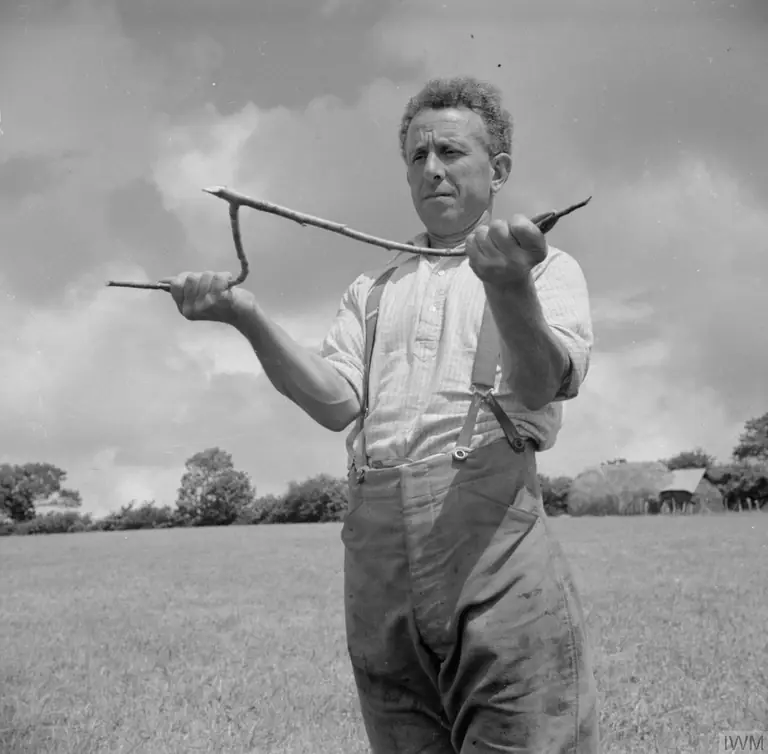
George Casely holding a hazel divining rod on his farm in Devon, England, 1942. Ministry of Information photograph, Imperial War Museums D 9817. Public-domain source record.
A forked branch and a question beneath the ground
Someone walks a piece of land holding a forked branch, watching for its tip to dip. Another person uses bent metal rods and waits for them to cross. The question is the same: where should the well go?
Dowsing, also called divining or water witching, has a place in New England's rural history and is still practiced there. It brings together the practical need for water, trust in a person who knows the land, and a method whose claims have not held up in controlled scientific tests.
From European mines to American fields
The US Geological Survey's history of water dowsing points to Agricola's De re metallica, published in 1556, for an early detailed account of the divining rod in German mining. The practice spread to England and became associated with searching for water as well as minerals.
European settlers carried the tradition to America. By 1917, repeated public questions had prompted the Geological Survey to publish A. J. Ellis's The Divining Rod: A History of Water Witching. Its existence is a reminder that the argument about dowsing is itself part of the history.
A tradition that remains visible in New England
The American Society of Dowsers was founded in Vermont in 1961 and retains its headquarters in Danville. Its 2026 events calendar lists instruction in Rutland, Vermont, and Pelham, New Hampshire. Those listings document a continuing practice, although they do not tell us how many of the region's wells are located this way.
There are older local records too. The Maine Historical Society's 1979 photograph from Brunswick records a landowner asking dowser Harvey Howells to search his River Road property. Following a record like that can lead to a useful question for your own family: who chose the site of the well, and what do people remember about it?
What a successful well can tell us
A well that produces water is a real result. It does not establish that the rod identified a location another method would have missed. The Forest Service's groundwater technical guide, in its dowsing section, reports that controlled tests have not found success beyond chance.
Groundwater can occupy pores in sediment and fractures in rock across a broad area. The USGS explains why finding water somewhere beneath a property can make an apparent success less surprising. A useful household supply also depends on depth, yield, quality, and how it holds up under use. The movement of a stick does not measure those things.
Let the story lead to a better record
If there is a dowser in your family's well story, write down the person's name, the date, and what was predicted. Look for the drilling record and compare the remembered depth and yield with the documented result. Include an unsuccessful attempt if someone remembers one. You are preserving an account, not asking a family story to carry more proof than it contains.
For a new well, begin with local geology, nearby well records, applicable siting requirements, and a qualified well professional. Ask how the proposed site will be evaluated and the finished well tested. Once water reaches the house, follow a laboratory testing plan such as the one in Growing up on well water.
Begin with the well you know
Find its record, ask someone how the location was chosen, and put the account beside the facts you can check. A familiar piece of land can hold both an interesting tradition and questions worth investigating. Carry those questions into a field notebook, and see what the next conversation adds.
I hope this finds you well,
Scott