
What got us through the winters
I grew up in northern Maine, the youngest of five, in a town of about 200 people. My dad was a preacher who made around $17,000 a year. What got us through the winters was my mom's garden.
She grew enough to feed seven of us through the cold months. Nothing went to waste. When a moose was hit by a logging truck down the road, my parents brought home a leg, and she made moose lasagna.
That is the scale of resourcefulness I remember. Your first storage crop can begin much more modestly, with a row of carrots or a few winter squash. Give it a destination before planting it.
Choose something you will cook
Write down the vegetables you buy repeatedly through winter. Potatoes, carrots, beets, onions, garlic, cabbage, and winter squash are possibilities, but their varieties and keeping conditions differ. Choose seed described for storage, then check its growing season against your local planting window.
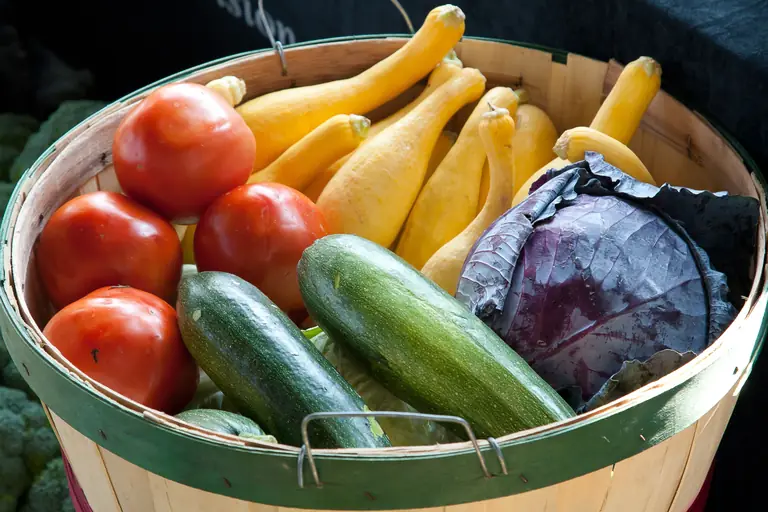
A harvest basket can hold vegetables with very different needs. The summer squash and tomatoes pictured here need eating or preserving much sooner than a sound storage squash. “Homegrown” does not give every crop the same shelf life.
Match the crop to a real place
Read Maine Extension's guide to storing vegetables and fruits and measure the temperature where you intend to keep food. A spare cupboard, a basement, and an unheated shed are different environments. Avoid freezing, pests, and places exposed to fuel or other chemicals.
- Roots and cabbage generally need cold, humid conditions, with arrangements suited to each vegetable.
- Potatoes need darkness, cool temperatures, and appropriate humidity. Check the crop's curing and storage directions before packing.
- Dry onions and garlic need curing followed by dry, ventilated storage.
- Winter squash needs a warmer, relatively dry place. Keeping time varies considerably by type.
You do not have to create all those conditions. Start with the crop that matches what you have, or choose a different way to preserve it.
Harvest for keeping
Handle produce gently and set aside damaged pieces for prompt use where sound and suitable. Do not pack decay into a storage box. Curing is crop-specific: a blanket instruction to leave everything in the sun will not do. Minnesota Extension's postharvest guidance explains those differences, including why acorn squash does not benefit from curing.
Label containers with the crop, variety, and harvest date. Leave access so you can inspect them regularly, remove spoiled pieces, and use those that are keeping least well. Your notes can be simple: what went in, where it stayed, and when you finished it.
Preserve what will not keep fresh
The National Center for Home Food Preservation has tested directions for freezing, drying, fermenting, and canning. Follow the method for the exact food. Low-acid vegetables require a tested pressure-canning process; a sealed lid alone does not establish safety. Freezing may be the more practical choice if you have the space and follow the crop's preparation instructions.
Plan a crop you can follow through
Choose a vegetable, find a storage variety, and write down the harvest and keeping method. A garden log can hold those decisions alongside what actually happened. There is something satisfying about knowing which meal began in the garden months before.
I hope this finds you well,
Scott